Shopify Store Credit Report: How It Influences Refunds, Loyalty, and Revenue Growth

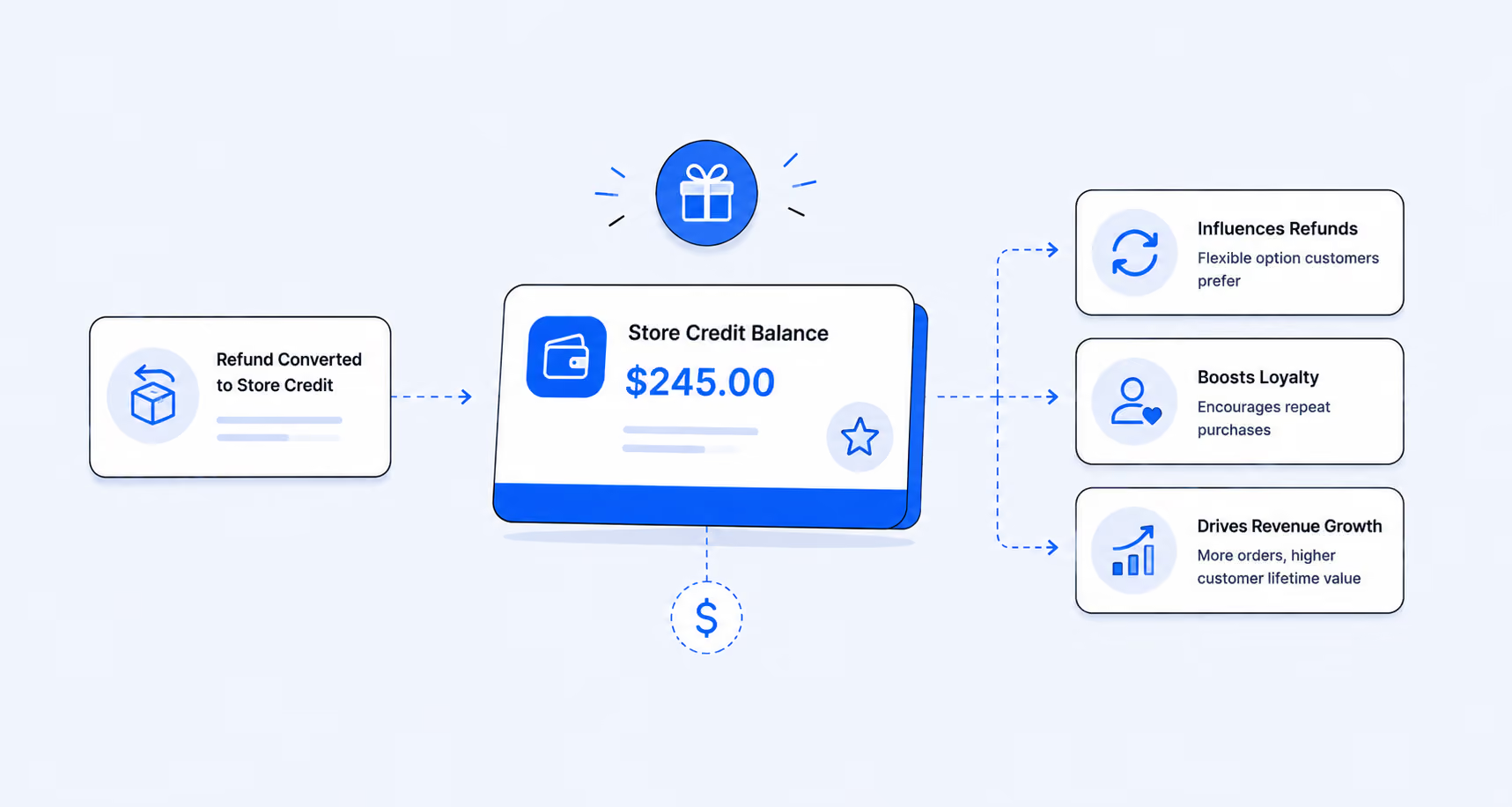
Returns are one of the biggest challenges for retail businesses because you put time, effort, and money into making a sale, and then the product comes back, the payment leaves your account, and the item sits on your shelf. Each return reduces your revenue, disrupts your cash flow, and creates extra work for your team, so over time it quietly drains your business.
A better approach is to offer customers store credit instead of issuing cash refunds, as the money remains within your business, and customers have a reason to return and shop again. This approach not only protects your revenue but also encourages repeat business and fosters stronger customer loyalty. By doing this, what once felt like a loss can become an opportunity for growth.
How Store Credit Works?
Although Shopify does not have a built-in native store credit feature, merchants can implement and manage store credit through third-party apps or custom workflows, like within the
Analytics > Reports section in the Finance category.
When a customer returns an item, you can offer store credit instead of a cash refund, which keeps the money in your business while still giving the customer something of equal value.
For example, imagine a customer buys a jacket for $100 but decides to return it. Instead of giving them $100 in cash, you give them $100 in store credit. They can then use this credit to buy something else, like a pair of shoes or a bag.
Here’s how it works:
- The amount of store credit usually matches what the customer paid for the returned item.
- Customers can only spend it at your store, not at other stores.
- It helps your business because the money stays with you instead of leaving as a cash refund.
- It encourages customers to come back and shop again.
The Core Difference Between Store Credit & Gift Card
Store credit and gift cards are both tools retailers use to drive customer retention and revenue, but they are issued and accounted for very differently. Their impact on financial reporting, customer analytics, and business strategy also varies significantly.
- Gift Cards: Treated as sold products when issued (sales revenue deferred until redemption), liability decreases as cards are used, and eventually revenue is recognized.
- Store Credit: Always a liability until redeemed, not booked as new sales upon issuing. Store credits are usually issued as part of a return, and a credit replaces what would otherwise be a refunded payment.
- Gift cards often account for a large amount of "unearned" revenue (potential future sales).
- Store credits retain prior revenue by preventing cash outflows, reflecting revenue saved from potential refunds.
Enhance Your Store Credit Reports with Additional Fields
Although Shopify lacks a built-in store credit report, here’s how it works and why it matters. You can amazingly enhance your Store Credit Reports in third-party apps (especially when using Report Pundit) by extending your data sources and adding specific custom fields related to orders, customers, payments, and refunds. Below are the best practices and field suggestions you can implement by adding:
- Order Details: To map store credit use to specific transactions
- Customer Details: To identify who uses store credit most frequently
- Tracking Refund Type: To track how refunds impact your store credit balances
- Payment Method: To distinguish credit usage from other payments
Key Insights from Your Store Credit Reports
Track the full lifecycle of store credit for every customer, when it was issued, how much was redeemed, and what remains unused or has expired. This provides clear visibility into active liability, breakage (unused credit that has expired), and actual redemption patterns. Use Shopify's reports or analytics solutions to drill into each event's timestamp for compliance, forecasting, and revenue recognition.
Store Credit Redemption Rate
This metric measures what percentage of issued store credit is actually redeemed by customers versus the portion that remains unused. A high redemption rate suggests effective customer engagement and successful credit campaigns, while a low rate may indicate missed opportunities or a need for improved promotion of credit utility.
Store Credit Issued as Refunds
Comparing the frequency and volume of store credit issued for refunds (versus cash refunds) reveals how well you are retaining revenue internally. Each credit refund essentially “locks” more spend within your store, which can increase the return customer rate and protect your cash flow.
Payout Impact: Credit vs. Other Gateways
Analyzing transactions paid with store credit versus cards, cash, or PayPal helps you understand how credit shapes your payment mix. Store credit keeps funds in your ecosystem, reduces payment gateway fees, and speeds up purchase cycles because there’s no external collection.
Effect on Customer Lifetime Value (LTV)
Compare the LTV of customers who use store credit to those who don’t. Credit users are typically retained longer, have higher purchase frequency, and demonstrate greater loyalty. Quantifying this impact justifies investment in credit-based loyalty or refund strategies.
Timing & Patterns of Redemption
Analyze when credits are most often redeemed and the period right after the store credit is given to the customer, seasonally, after returns, or during promotions. Spotting these trends can inform timing for targeted campaigns, credit expiration policies, and aligning offers with customer shopping cycles.
Average Order Value (AOV) with Credit
Track whether using credit at checkout correlates with higher AOV, for example, if customers top up baskets to maximize credit or indulge in upsells. Many stores report increased AOV when credit is used compared to typical transactions.
Store Credit vs. Discounts Comparison
Evaluate which incentive, store credit or discounts and deliver better results at a lower cost. Store credit often outperforms simple discounts for long-term loyalty, revenue retention (since unused credit is breakage), and more frequent repurchase, while discounts have an immediate but sometimes less sticky impact.
Customer Loyalty & Usage Analysis
This analysis helps you understand how customers use and respond to store credits. By identifying who redeems credits most frequently, you can pinpoint your most engaged or refund-prone customers. High redemption activity may signal two possible patterns:
- Positive engagement (loyal customers returning for more purchases).
- Product-level issues (frequent refunds leading to repeated credit issuance).
Tracking top credit holders and redeemers highlights segments worth targeting for retention campaigns or satisfaction checks. It also supports loyalty analysis, revealing how store credit usage drives repeat transactions, helps increase average order value, and boosts long-term customer lifetime value.
Credit Liability vs. Redemption Trend
This report examines the financial movement of store credit over time, and issued, redeemed, and expired. Plotting these trends on a monthly or quarterly basis shows whether your credit liability (unredeemed balance) is expanding or contracting.
- If issued store credits consistently exceed redemptions, the liability is growing, suggesting funds remain unused or are expiring too slowly (Shopify allows merchants to set expiration dates on issued credits.
- If redemptions track closely to issuances, it means customers are actively using credits, which strengthens engagement but also reduces liabilities.
Analyzing these patterns helps monitor breakage (unused credits), assess the sustainability of credit programs, and ensure accurate revenue forecasting for financial stability and compliance.
How Report Pundit Helps You Analyze Store Credit Transactions
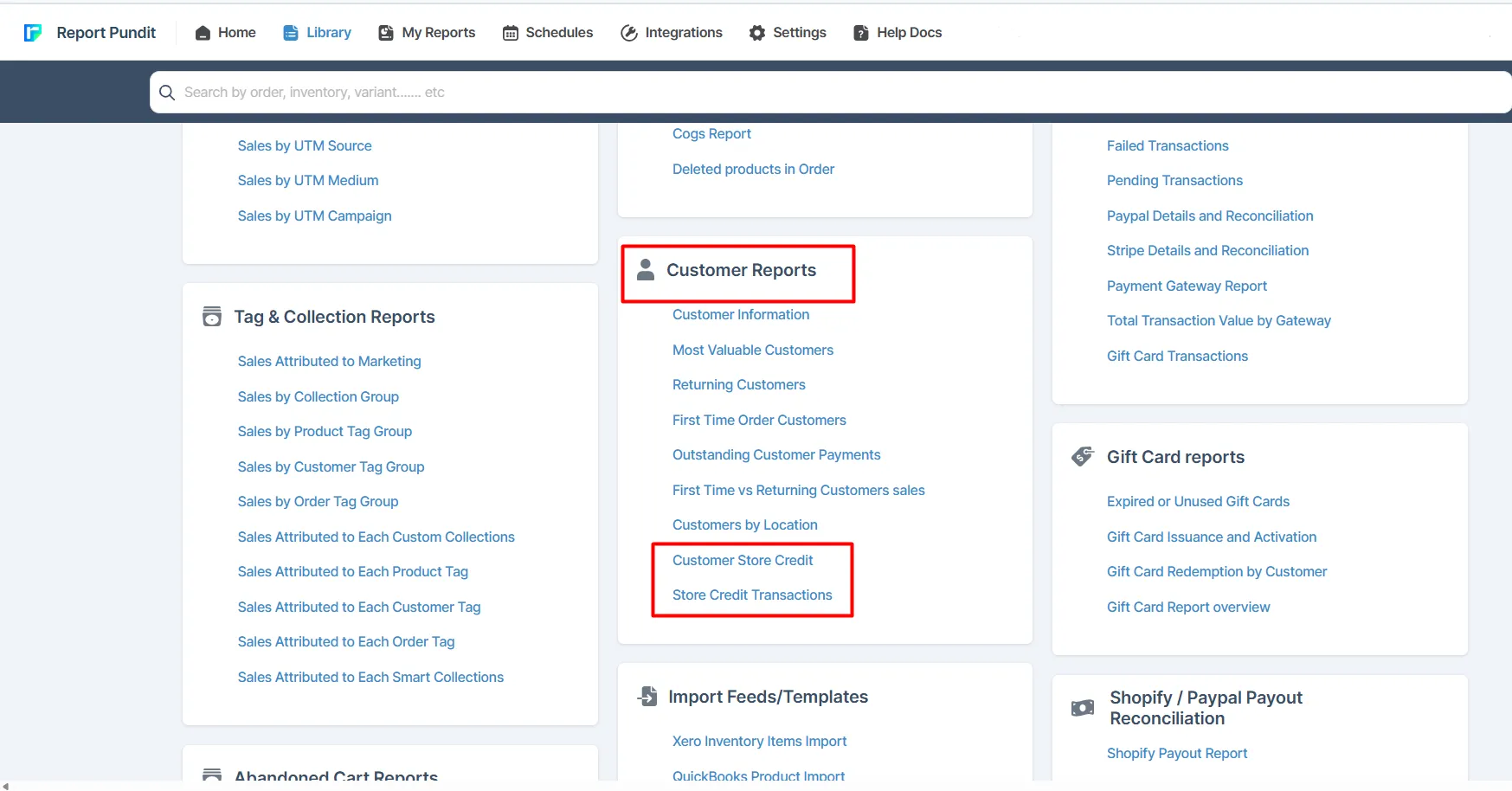
Report Pundit includes a Store Credit report as part of its advanced financial and customer analytics suite. This report helps Shopify merchants track, analyze, and reconcile store credit transactions issued to customers and whether from refunds, loyalty programs, or manual credit adjustments.
Store Credit Report Overview
Report Pundit’s store credit functionality enables merchants to:
- Track store credit issuance and usage, showing which customers received or redeemed credits and on which orders.
- Reconcile refunds processed as store credit against total issued credits for accurate financial reporting.
- View details at the customer, order, or transaction level, including dates, amounts, and balance adjustments.
Fields and Filters
A typical Store Credit report can be customized to include:
- Order date and ID
- Customer name, email, and contact
- Credit issued and redeemed values
- Payment method used (e.g., store credit + other payment combinations)
- Associated refund or loyalty segment
Advanced filters allow merchants to refine by:
- Date range
- Customer group or segment
- Refund type (store credit vs cash/card refund)
- Product, SKU, or collection attribution.
Automation and Exporting
Report Pundit supports automated scheduling and exports for store credit reports. Reports can be sent periodically to:
- Google Sheets, Excel, or email
- Integrate with apps like PayPal, POS, and Stocky for combined financial tracking.
Availability
The Store Credit report is classified under Customer pre-built report templates and can be further customized by Report Pundit’s support team at no additional charge.
This report provides merchants with complete transparency into how store credit affects customer retention, refunds, and financial balance, while offering multi-store and multi-currency compatibility for consolidated reporting.
Conclusion
Setting up a well-organized Shopify store credit system can turn returns from a loss into a growth opportunity because merchants can issue store credits instead of cash refunds. This keeps money in the business and encourages customers to come back while increasing repeat sales. Store credit protects revenue and improves cash flow, and it also builds customer loyalty by motivating repeat purchases and upsells.
When businesses track credits using detailed reports that show orders, customers, refund types, and payment methods, they gain a clear understanding of how credits are used and redeemed. In simple store credit is not just an alternative to refunds but a smart way to retain customers and grow your store.

5.0 ( 2000+ Reviews)
